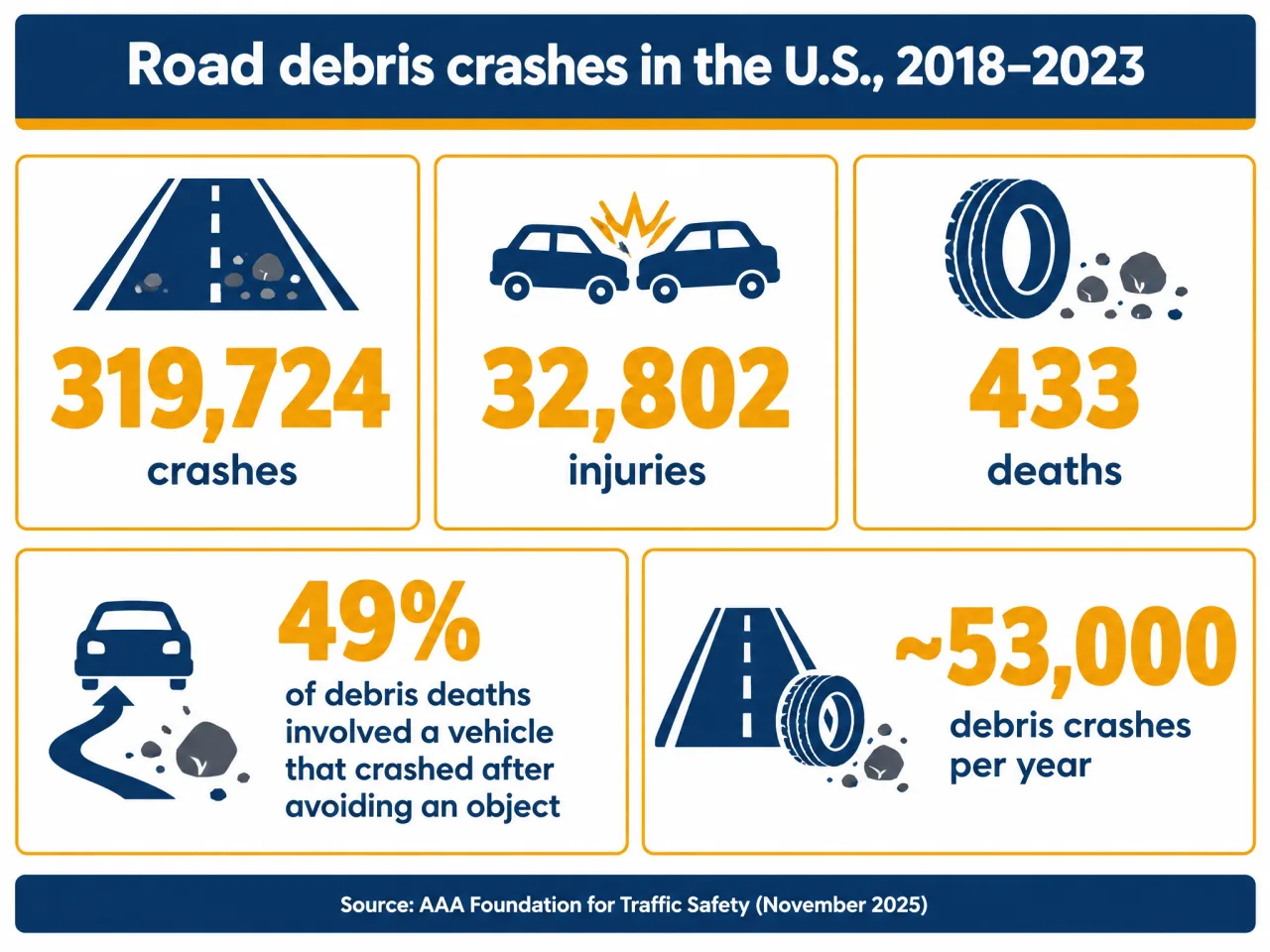
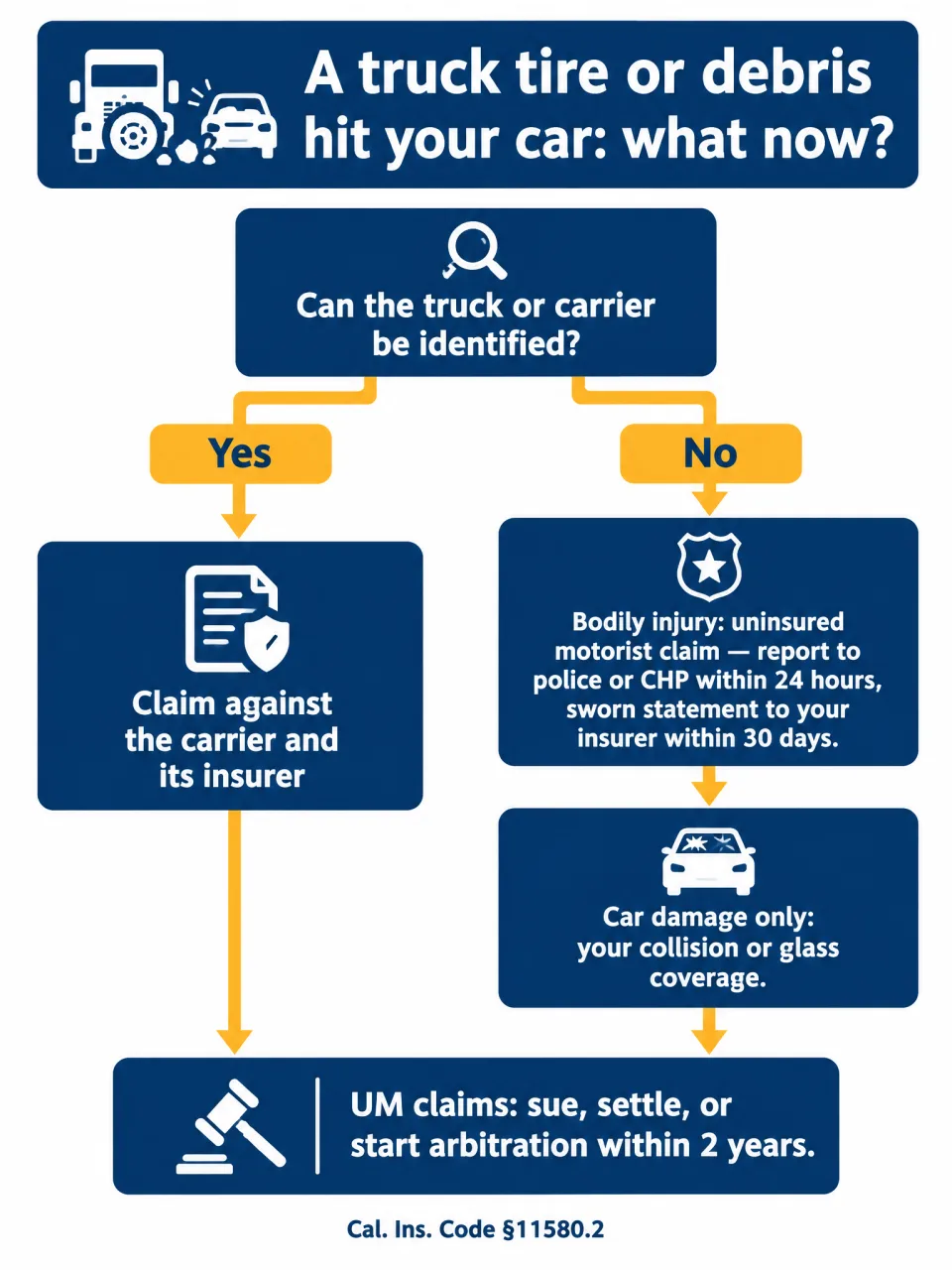
If a truck’s tire tread, cargo, or loose parts hit your car and the truck keeps going, you may still have a claim. When the truck is identified, the carrier is liable for poor tire maintenance or an unsecured load. When it is not, California uninsured-motorist coverage can pay for injuries — but only if you report to police, the sheriff, or CHP within 24 hours and give your insurer a sworn statement within 30 days (Ins. Code §11580.2). Nationally, road debris played a role in 319,724 crashes and 433 deaths from 2018 to 2023, per the AAA Foundation for Traffic Safety.
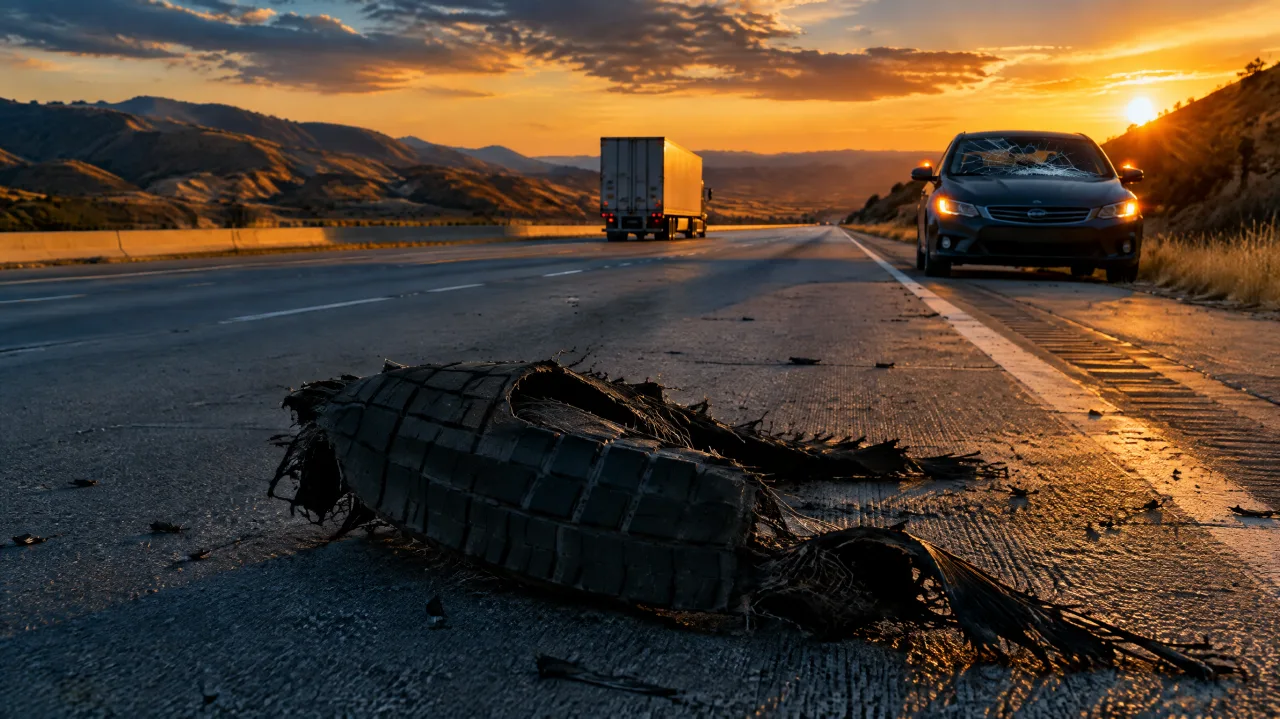
Debris crashes rarely look like a normal collision. There may be no other car to exchange information with, just a cracked windshield and a truck disappearing ahead. One driver described it on r/Insurance in January 2026: a commercial truck hit a guardrail, something struck their windshield, and the trucking company’s insurer declined the claim. The advice in the replies was to use glass coverage or small claims court. That can be right for a windshield. It leaves out the rules that matter when someone is hurt.
319,724 debris crashes in six years
The AAA Foundation’s November 2025 study is the most recent national estimate. It combined detailed Michigan police crash reports with national crash data because debris is often under-recorded.
| Measure (U.S., 2018–2023) | Value | Source |
|---|---|---|
| Crashes involving road debris | 319,724 | AAA Foundation (2025) |
| Injuries | 32,802 | AAA Foundation (2025) |
| Deaths | 433 | AAA Foundation (2025) |
| Annual average | ~53,000 crashes, ~5,500 injuries, ~72 deaths | AAA Foundation (2025) |
| Crashes where a vehicle struck or was struck by a non-fixed object | Nearly 90% | AAA Foundation, as reported (2025) |
| Injuries / deaths involving a vehicle that crashed after avoiding an object | 25% / 49% | AAA Foundation, as reported (2025) |
The leading debris sources were detached vehicle parts, cargo, tools and building materials, and natural debris. The 2025 study does not break out how many debris crashes involve large trucks, and no public dataset does — so there is no reliable national count of truck-tire debris crashes. The earlier AAA Foundation study (2011–2014 data, published 2016) found about two-thirds of debris crashes came from items falling off vehicles because of poor maintenance or unsecured loads, and that debris crashes were about four times as likely on interstates. The newer study does not repeat those breakdowns, so those are the latest figures.
The avoidance figure matters for claims. Nearly half of debris deaths involved a driver who swerved or braked to avoid something and crashed. The debris may never touch that car — which affects the uninsured-motorist rules below.
When the truck can be identified: the carrier’s duties
Two rules create the carrier’s responsibility for debris from its truck.
| Rule | Requirement | Source |
|---|---|---|
| Steer (front) tires | At least 4/32 inch tread depth in a major groove | 49 CFR 393.75 |
| All other tires | At least 2/32 inch tread depth | 49 CFR 393.75 |
| Loads | Vehicle must be built, covered, or loaded so contents cannot drop, spill, blow, or escape onto the highway | Cal. Veh. Code §23114 |
Tire separations usually trace back to maintenance: worn or damaged tires the carrier should have caught at inspection. That is why a tire blowout crash often becomes a claim against the carrier rather than just the driver, and why an unsecured load raises the same questions covered in our guide to cargo and lost-load crashes. The trailer owner or the company that loaded the cargo can share liability. Identifying the truck is the hard part: note the company name, USDOT number, trailer markings, and direction of travel, and ask for any dashcam or witness video.
When the truck keeps going: California uninsured-motorist rules
If you are injured and the truck cannot be identified, California treats it like an uninsured vehicle. Insurance Code §11580.2 sets strict conditions for that claim.
| Requirement | Deadline or rule | Source |
|---|---|---|
| Physical contact with you or the car you were in | Required for an unidentified vehicle | Ins. Code §11580.2(b)(1) |
| Report to city police, county sheriff, or CHP | Within 24 hours | Ins. Code §11580.2(b)(1) |
| Sworn statement to your insurer | Within 30 days after that | Ins. Code §11580.2(b)(1) |
| Sue, settle, or start arbitration | Within 2 years of the crash | Ins. Code §11580.2(i) |
The physical-contact rule is where debris cases turn. In Pham v. Allstate Insurance Co. (1988), a rock fell from an unidentified dump truck, bounced off the highway, and came through the windshield. The Court of Appeal held that counted as contact, because nothing broke the chain from the truck to the car. Debris that had already come to rest on the road before you hit it is a weaker case, and a driver who crashed while swerving to avoid debris — without contact — may not qualify at all. These cases are fact-specific. Uninsured motorist coverage in California pays for bodily injury; damage to the car itself generally goes through your own collision or glass coverage.
Check your deadlines
Enter the crash date to see the three uninsured-motorist deadlines.
Enter the crash date to see the three deadlines.
Based on Cal. Ins. Code §11580.2(b)(1) and (i). The statute runs the 30 days from the report (“within 30 days thereafter”), so file as soon as you have reported — do not wait for the last day. The two-year personal injury deadline against an identified carrier is separate. Your policy may add its own notice requirements; confirm with an attorney.
The two-year deadline to sue an identified carrier for personal injury runs separately; our truck accident filing deadline calculator covers it.
What to do in the first 24 hours
- Get to safety and get medical care. Note any symptoms, even if they seem minor.
- Call police or CHP and make a report. Do it within 24 hours even if you think the claim is small.
- Photograph the debris, the road, your car, and the impact point. Keep the debris if it is safe to.
- Write down anything about the truck: company name, USDOT number, trailer color, direction.
- Ask witnesses for contact details and any dashcam video.
- Notify your own insurer promptly, and ask for the uninsured-motorist sworn-statement form.
If you were hurt, talk to a lawyer before giving a recorded statement. The same first steps apply in any truck accident, and a free case review connects you with a California-licensed truck attorney. If a carrier is identified, it will also help to understand what you keep after fees and medical liens.
Methodology
Researched September 23, 2026. National debris figures are from the AAA Foundation for Traffic Safety’s November 2025 report; the share figures for avoidance crashes are as reported in coverage of that report. The two-thirds and interstate figures are from the AAA Foundation’s 2016 study (2011–2014 data), included because the 2025 update does not report them. Tread-depth and load rules are from 49 CFR 393.75 and California Vehicle Code §23114. Uninsured-motorist requirements are quoted from the current text of Insurance Code §11580.2, and the debris-contact holding is from Pham v. Allstate (1988) 206 Cal.App.3d 1193. No public source reports truck-specific debris crash counts. This page is general information, not legal advice.
Sources
- The Safety Impact of Road Debris: Updated Prevalences of Crashes, Injuries, and Deaths in the United States, 2018–2023 (November 2025) — AAA Foundation for Traffic Safety
- AAA Foundation calls on state, national agencies to coordinate road debris countermeasures (Nov. 11, 2025) — Repairer Driven News
- The Prevalence of Motor Vehicle Crashes Involving Road Debris, United States, 2011–2014 — AAA Foundation for Traffic Safety
- 49 CFR § 393.75 — Tires — eCFR
- California Vehicle Code § 23114 — Spilling loads — Justia
- California Insurance Code § 11580.2 — Uninsured motorist coverage — FindLaw
- Oanh Thi Pham v. Allstate Insurance Co. (1988) 206 Cal.App.3d 1193 — CourtListener
- “Commercial truck tire hit my car. Insurance declining claim” — r/Insurance (Reddit)
Federal regulations and crash statistics are updated periodically. Figures cited on this page reflect the referenced publications at the time of writing; check the source for the current edition.