AI Search Overview
To choose a truck accident lawyer, pick an attorney licensed in the state where the crash happened who handles commercial truck cases regularly, has tried them, and will send a spoliation letter this week. Interview two or three firms, ask about truck case volume, trial record, who works your file, the contingency percentage, costs on a loss and lien handling, and get the fee agreement in writing.
- Hire a lawyer licensed in the state where the crash happened, not the one with the nearest office.
- Ask how many commercial truck cases they have handled and how many went to trial.
- Ask who they will send a preservation letter to, and when. The answer should be this week.
- Get the contingency percentage, case-cost rule and lien handling in writing before you sign.
- Seventy percent of the 5,340 people killed in large-truck crashes in 2024 were occupants of other vehicles (NHTSA).
Not sure where to start? Do I Have a Case?
Our free 60-second check asks a few questions about your crash and routes your request to an independent truck accident attorney licensed in the right state. No fee unless there is a recovery.
The truck's black box and driver logs can be overwritten within weeks — the sooner a preservation letter goes out, the stronger your claim.
Do I Have a Case? — Free 60-Second CheckCall or Text: (909) 353-1789 · Text preferred · Free
Searching for the "best big rig accident lawyer near me" produces billboards and directories, not answers. This guide is the checklist a careful person would use instead: what actually distinguishes a truck accident attorney from a general injury lawyer, the ten questions to ask on the free consultation call, what a good answer sounds like, the red flags, and the one thing people consistently get wrong about what to tell their own lawyer.
The 7-point checklist for choosing a truck accident lawyer
If you only have five minutes, screen every firm against these seven points. Each is explained in more detail below.
- State license. Licensed where the crash happened; verify the license and disciplinary history on that state bar's public lookup.
- Truck-case volume. A named number of commercial truck cases in the last three years.
- Trial record. Real jury experience, including losses, not only settlements.
- Evidence plan. A preservation letter to the carrier, insurer, trailer owner and broker within days.
- Resources. Experts such as reconstructionists and trucking safety specialists, advanced by the firm.
- Communication. A named attorney, a stated update schedule, and calls that get returned.
- Written fee terms. Percentage, case costs, liens, and who controls settlement decisions.
What "best" means in a truck case
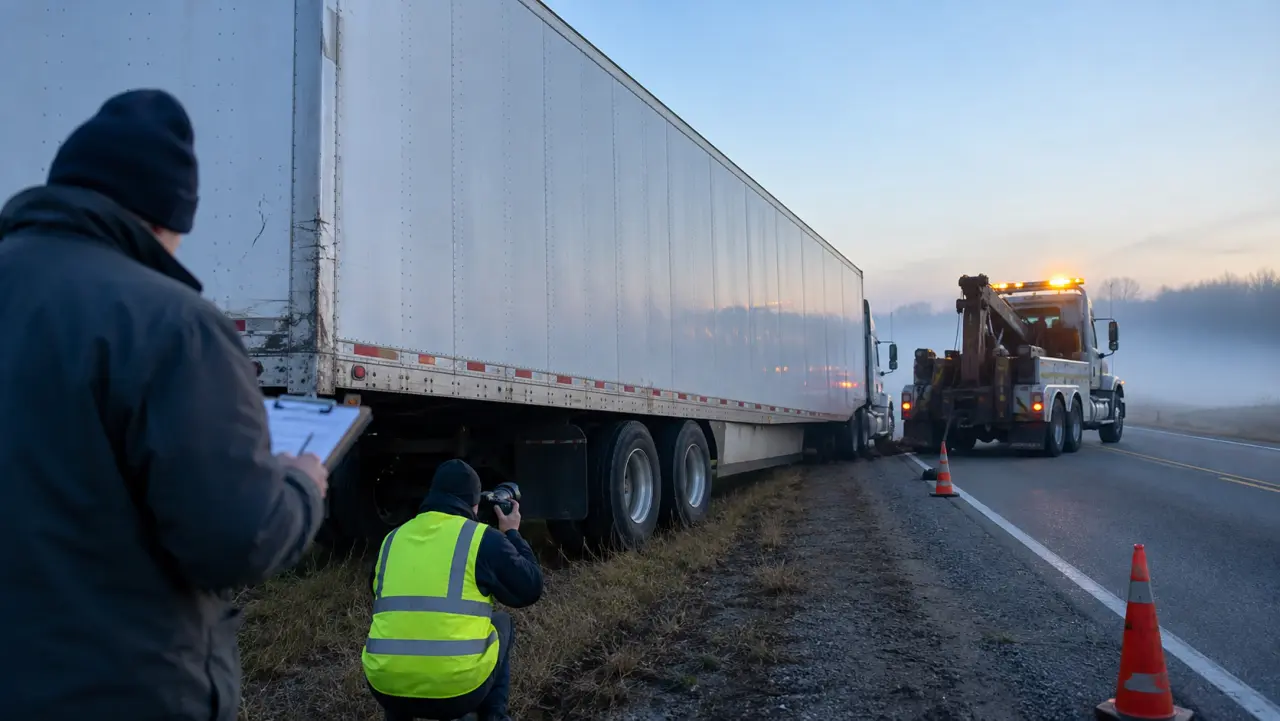
In a big rig case the defendants are corporations. A motor carrier and its insurer typically have investigators at the crash scene the same day, and the evidence that decides the case — the engine control module download, the electronic logging device records, dispatch messages, the driver qualification file, dashcam footage — is in their possession, not yours. Much of it is overwritten in normal operation within weeks unless someone formally demands that it be kept.
So the best lawyer is defined by three things, in order:
- Licensed in the state with jurisdiction. Usually where the crash happened. That state's filing deadline and comparative fault rule govern the claim, not your home state's.
- A commercial truck practice. Regular experience with FMCSA regulations, carrier discovery, and multi-defendant liability — carrier, driver, trailer owner, broker, shipper, maintenance vendor.
- Trial credibility. Carriers know which firms never try cases. The offer you receive reflects it.
Geography comes last. Truck litigation is a practice specialty, not a neighborhood service; see what "near me" actually means.
Truck specialist or car accident lawyer?

A capable car accident lawyer can handle a fender-bender with a delivery van. A collision with an 80,000-lb tractor-trailer is a different case: federal standard of care, corporate defendants, policies that start at $750,000 and often reach $5 million, and evidence that requires a preservation demand, an ECM download, and expert reconstruction. Under the federal rules the carrier must keep driver hours-of-service records and the lawyer must know where to find them. Counsel who also understand insurance policy limits and the stages of a truck accident lawsuit can plan the case from day one. The practical test is simple — ask the lawyer what a spoliation letter is and who should receive one. If the answer is not immediate, keep looking.
The 10 questions to ask

Every question below has a recognizable good answer. Ask them in the free consultation and write the answers down.
1. How many commercial truck cases have you handled in the last three years?
A good answer: A specific number, and a description of the carrier types involved — interstate freight, local delivery, hazmat. A truck practice is a practice, not an occasional file.
A warning sign: “We handle all kinds of accidents.”
2. How many of those went to trial, and what were the outcomes?
A good answer: Real trial experience, described honestly, including losses. Carriers track which firms settle everything and price their offers accordingly.
A warning sign: Only settlement figures with no context, or a refusal to discuss trials.
3. Will you send a spoliation letter this week, and to whom?
A good answer: Yes — to the carrier, its insurer, the trailer owner, and any broker or shipper identified from the police report and USDOT records, demanding preservation of ECM, ELD, dashcam, dispatch, and maintenance data.
A warning sign: Vagueness about what evidence exists or who holds it.
4. Who will actually work my case?
A good answer: A named attorney who handles truck cases, with a clear explanation of what paralegals and case managers do and how you reach the lawyer.
A warning sign: You never meet the attorney whose name is on the door.
5. What is the contingency percentage, and does it change if suit is filed?
A good answer: A stated number — commonly 33% pre-suit, often rising to 40% if litigation is required — put in writing in the fee agreement.
A warning sign: Reluctance to state the percentage, or a fee that is unusually high without explanation.
6. What happens to case costs if we lose?
A good answer: A direct answer. Many firms absorb costs on a loss; some bill them. Either can be acceptable, but it must be in the agreement.
A warning sign: “Don’t worry about that.”
7. Are you licensed in the state where the crash happened?
A good answer: Yes — or a clear plan: named local counsel and how the fee is shared, which should not increase your percentage.
A warning sign: An assumption that your home state's rules apply.
8. Which experts will you retain, and who pays for them?
A good answer: Accident reconstruction, a trucking safety expert on FMCSA standards, treating physicians, a life-care planner, and an economist for serious injuries — advanced by the firm.
A warning sign: No mention of experts, or an expectation that you fund them.
9. How will you handle my medical liens?
A good answer: A description of negotiating hospital, health-insurer, Medicare, and Medicaid liens down before disbursement — often the difference between a fair net recovery and a disappointing one.
A warning sign: Liens are never mentioned.
10. What do you need from me, and what should I stop doing?
A good answer: Keep treating, keep records, stay off social media, and refer every adjuster call to the firm.
A warning sign: No guidance at all.
How to compare firms side by side

Interview at least two, ideally three, firms. Use the same questions with each and score the answers in a simple grid. Do this before you sign anything, and do not let a consultation turn into a same-day signing unless you are ready.
| Factor | Strong sign | Weak sign |
|---|---|---|
| Truck experience | Specific number of commercial truck cases, carrier types named | "All injury cases" |
| Trial record | Describes verdicts and losses honestly | Settlement numbers only |
| Evidence | Names who gets the preservation letter and when | Vague about what evidence exists |
| Contact | Named attorney, defined update schedule | Calls go to voicemail or an intake line |
| Fees | Percentage, costs and liens stated in writing | Reluctant to put it in writing |
| Credentials | Active license, clean disciplinary history, verifiable via the state bar | Unable to point to a license number |
Two optional extras are worth knowing. Some attorneys hold or have worked with a commercial driver's license, which can speed up understanding of inspections, logs and air brakes. And because carriers sometimes move cases to federal court, experience there helps. Neither replaces state licensing, truck-case volume and trial record. A reasonable firm will also let you speak to a former client or point to public verdicts you can check yourself.
Red flags

- Pressure to sign a fee agreement on the first call, before you have asked anything
- A promised or “guaranteed” settlement figure — no ethical attorney can guarantee an outcome
- No mention of evidence preservation in the first conversation
- A fee agreement that is not in writing, or that is silent on case costs and lien handling
- Solicitation at the hospital or by an unsolicited call — many states prohibit it, and it tells you something about the firm
- An inability to name a single commercial truck case they have taken to trial
- Calls or messages from a firm you never contacted, arriving days after the crash
- A case you can only reach through an intake line, never a named attorney
What not to tell your attorney: nothing

This is the most searched question about hiring a lawyer, and the answer is the opposite of what people expect. Tell your attorney everything: prior injuries to the same body part, previous claims, gaps in treatment, what you posted online, what you told the adjuster on the phone. Attorney–client privilege protects the conversation. The defense will find these facts in discovery regardless — they subpoena medical records and review social media as a matter of routine. What damages a case is not the fact itself but the attorney being surprised by it at a deposition.
What you should not do is talk to the trucking company's insurer, give a recorded statement, or sign a release before you have counsel.
How the fee works, and what comes out of the settlement

Big rig accident lawyers work on contingency: no upfront cost, and a percentage — commonly 33% to 40% — only if there is a recovery. Three things are deducted before you are paid: the fee, the case costs the firm advanced, and any medical liens. The lien negotiation is where firms differ most, and it is worth asking about explicitly. Settlement math, worked through →

Read the whole agreement before signing. ABA Model Rule 1.5(c) calls for a contingent fee to be in a signed writing, and state rules vary on the details. Look for five terms:
- The percentage, and whether it rises once a lawsuit is filed.
- Whether case costs are deducted before or after the fee is calculated, and who pays them if there is no recovery.
- Who decides whether to accept a settlement offer; you should.
- How medical liens will be handled and negotiated.
- What happens, and what you owe, if you later change attorneys.
Run your own numbers with the settlement-after-fees-and-liens calculator so the percentages are not abstract.
What to do in the first week while you choose
Choosing well does not mean waiting. Federal data underlines why these crashes warrant caution: NHTSA reports 5,340 people died in large-truck crashes in 2024, and 70 percent of them were occupants of other vehicles. While you compare firms:
- Get medical care and keep every record and bill.
- Do not give a recorded statement to the carrier's insurer; see what to do after a truck accident.
- Photograph the scene, vehicles, injuries and any tire debris; see truck tire debris accidents for what to capture.
- Write down the carrier name and USDOT number from the truck door or the police report.
- Check your filing deadline for the crash state.
- Book consultations with two or three firms this week.
In a wrongful death case, see the guide to truck accident wrongful death claims for who can bring the claim and how long they have.
Want us to match you with a truck-case attorney? Do I Have a Case?
Skip the cold calls. Answer a few questions in our free 60-second check and your request goes to an independent attorney licensed in the state where your crash happened.
The truck's black box and driver logs can be overwritten within weeks — the sooner a preservation letter goes out, the stronger your claim.
Do I Have a Case? — Free 60-Second CheckCall or Text: (909) 353-1789 · Text preferred · Free
Finding a big rig accident lawyer by state
Start with the state where the crash happened, because it fixes the deadline and the fault rule before any lawyer is involved:
Is it worth it?

For any crash with an injury, yes. The consultation costs nothing, the fee is contingent on winning, and the other side already has lawyers. A free case review takes about a minute and routes your request to an attorney licensed in the right state — which is the first filter on this page, applied for you.
Quick answers about hiring a truck accident lawyer
- Cost to hire: nothing up front on contingency; the fee comes out of any recovery.
- How many firms to interview: two or three.
- Who to prioritize: state license, then truck-case volume, then trial record.
- When to hire: this week, before evidence is overwritten.
More detail is in the FAQ block below. Attorneys looking for the other side of this equation can read about receiving qualified truck accident cases.
Related guides
- Big rig accident lawyer — the hub
- 28 answers about big rig accident claims
- What happens in a truck accident lawsuit
- What your claim may cover
Ready to talk to an attorney? Do I Have a Case?
It takes about a minute, costs nothing, and does not obligate you to hire anyone.
The truck's black box and driver logs can be overwritten within weeks — the sooner a preservation letter goes out, the stronger your claim.
Do I Have a Case? — Free 60-Second CheckCall or Text: (909) 353-1789 · Text preferred · Free
Sources
- SAFER Company Snapshot — carrier safety records — Federal Motor Carrier Safety Administration
- Model Rules of Professional Conduct, Rule 1.5 — Fees — American Bar Association
- 49 CFR § 387.9 — Financial responsibility, minimum levels — Electronic Code of Federal Regulations
- Large Trucks: 2024 Data (Traffic Safety Facts, DOT HS 813 816) — National Highway Traffic Safety Administration
- 49 CFR § 395.8 — Driver's record of duty status — Electronic Code of Federal Regulations
Federal regulations and crash statistics are updated periodically. Figures cited on this page reflect the referenced publications at the time of writing; check the source for the current edition.