California gives you 2 years to file — but the truck's black-box data is routinely erased within 30 days.CA: 2 years to file, black box erased in ~30 days.Check your case now →
Truck Accident Injuries: Understanding the Long-Term Impact
By the Big Rig Truck Accident Lawyer editorial teamLast updated: 2026-09-09
Editorial note: Reviewed by a licensed attorney on 2026-09-20. The reviewer is not named here at their request. It is general legal information, not legal advice. Content is based on publicly available FMCSA, NHTSA, and IIHS sources and general legal principles. Laws vary by state and change over time — confirm anything that affects your case with a licensed attorney in your state.
Because a fully loaded big rig can weigh 20 times more than a passenger car, the forces involved in a truck collision are rarely comparable to an ordinary fender-bender. Injuries tend to be severe, permanent, and expensive — which is exactly why the value of a claim depends on documenting the full medical picture, not just the initial emergency room visit.
Burn injuries — from fuel fires and hazardous cargo ignition.
Wrongful death — when a big rig crash takes a loved one's life.
Why injury severity drives case value
Insurers value claims largely around the permanence and cost of the injury: future medical care, lost earning capacity, and the impact on daily life all scale with severity. A catastrophic injury claim typically requires a life-care planner and vocational expert to project decades of future costs — figures that never surface in a "quick settlement" offer made in the days after a crash. See how big rig settlements are valued, what compensation may cover and what to do after a truck accident to protect the record early.
Injuries and liability are connected
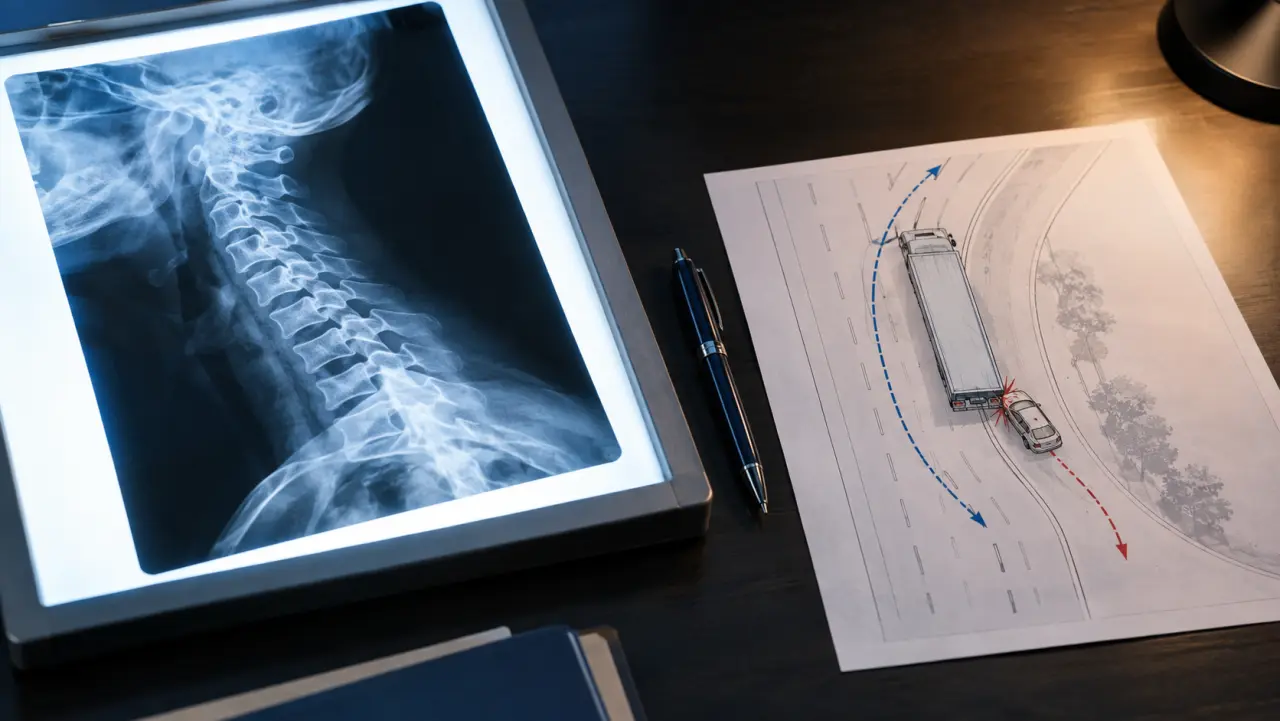
The type of injury often points back to the crash mechanism — underride crashes cause disproportionate head and crush injuries, rollovers cause spinal trauma, and cargo fires cause burns. Understanding how the crash happened and who can be held liable works hand in hand with documenting the injury itself.
What is the hardest injury to prove after a truck accident?
Injuries without a clear image: mild traumatic brain injury, chronic pain, soft-tissue and whiplash injuries, and PTSD. A fracture shows on an X-ray; a concussion with lasting cognitive symptoms often does not, and insurers dispute it aggressively. Proof comes from consistent medical treatment from day one, neuropsychological testing, treating-physician opinions, and documentation of how daily function changed.
What if my symptoms did not appear until days after the crash?
Delayed onset is common — concussion, whiplash, herniated discs, and internal injuries can surface days later once adrenaline fades. Get evaluated as soon as symptoms appear and tell the provider it followed a truck crash. Insurers use gaps in treatment to argue the injury came from something else, so the earlier the record starts, the stronger the claim.
Which injuries are most common in big rig crashes?
Traumatic brain injury, spinal cord injury and paralysis, fractures, amputation and crush injuries, burns, internal organ damage, whiplash and herniated discs, and psychological injury such as PTSD. Underride crashes produce disproportionate head and crush trauma; rollovers produce spinal injury; fuel and cargo fires produce burns.
Injured in a Big Rig Accident in California?
Find out in about 60 seconds whether you may have a case. It's free, confidential, and there's no obligation.
The truck's black box and driver logs can be overwritten within weeks — the sooner a preservation letter goes out, the stronger your claim.