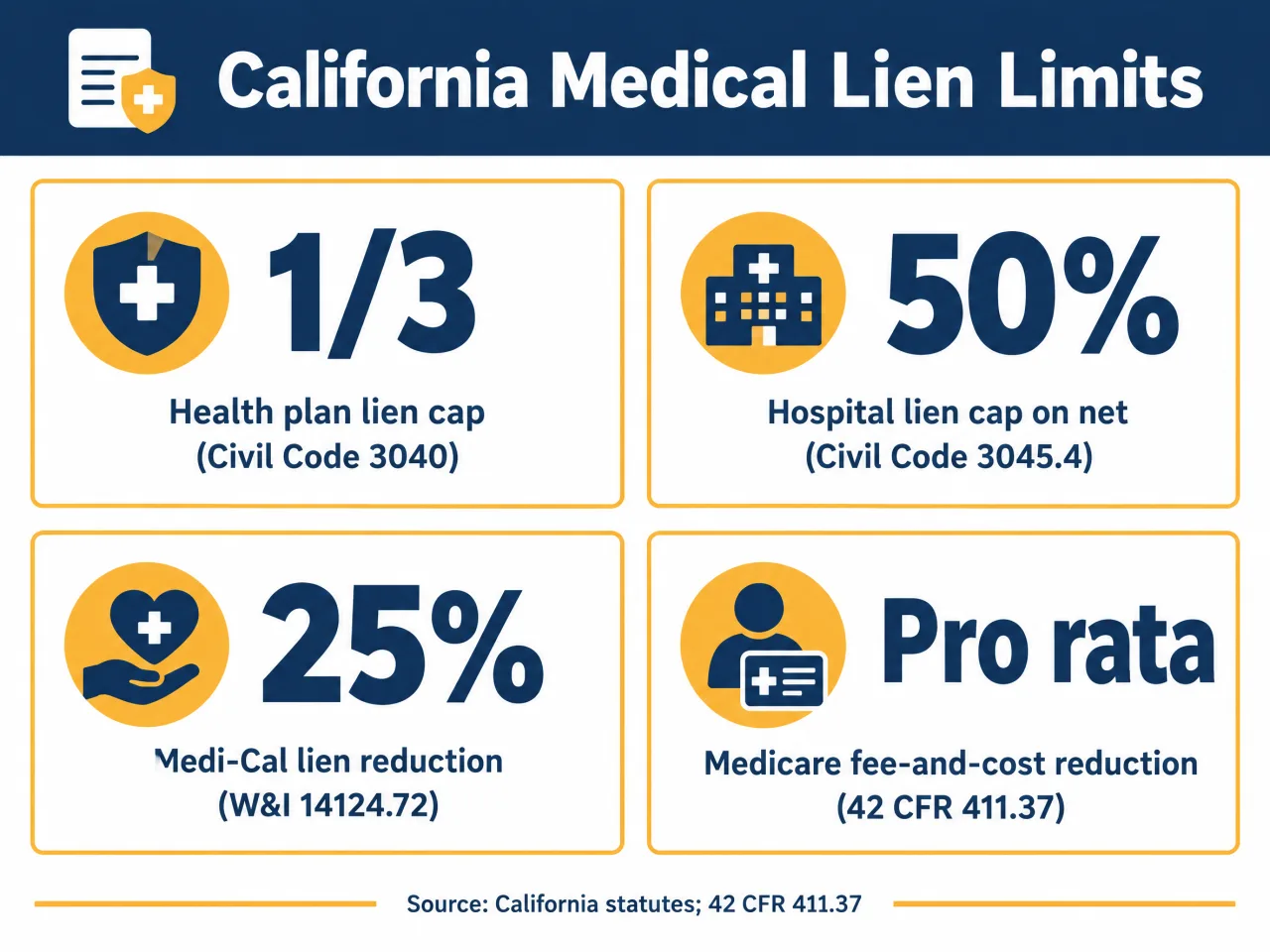
What you keep from a California truck accident settlement is the gross amount minus the attorney fee (commonly 33% to 40%), minus case costs, minus medical liens — and state law caps those liens. A private health plan with a lien cannot recover more than one-third of the settlement if you had a lawyer (Civil Code §3040). A hospital lien is limited to 50% of what is due you (§3045.4). Medi-Cal’s lien is cut 25% and can never exceed your net (W&I §§14124.72, 14124.78). Medicare shares the cost of the fee (42 CFR 411.37).

Most “how much will I get” pages stop at the fee. The fee is the predictable part. The number that surprises people is what comes out after it: advanced case costs and the medical bills that hospitals, health plans, Medicare, and Medi-Cal expect to be repaid. One Texas claimant posted a breakdown in September 2026: a $42,500 settlement, a 40% fee of $17,000, $4,239.47 in costs, and roughly $20,000 in medical balances — leaving $1,077.80. That is one person’s account, not a statistic, but it shows why lien math matters as much as the fee. This page applies California’s actual lien statutes to worked examples so you can see where the money goes in a big rig accident settlement.
The deduction order: fee, costs, then liens
Every settlement statement follows the same waterfall. The attorney fee is calculated on the gross. Case costs the firm advanced come out next. Liens are paid from what is left, and you receive the remainder.
| Step | What comes out | Governing rule |
|---|---|---|
| 1. Attorney fee | Percentage of the gross — commonly 33% pre-suit, often 40% after filing | Written agreement required, Bus. & Prof. Code §6147 |
| 2. Case costs | Filing fees, records, experts, depositions advanced by the firm | Must be explained in the fee agreement (§6147) |
| 3. Medical liens | Health plan, Medicare, Medi-Cal, hospital, or provider liens | Civ. Code §§3040, 3045.4; W&I §§14124.72, .78; 42 CFR 411.37 |
| 4. Net to you | Whatever remains | — |
The 33%–40% range is typical practice, not a statewide survey — no public dataset of California fee rates exists. What your fee is, and whether it steps up if a lawsuit is filed, is something to confirm before you sign; our guide on what to ask a truck accident lawyer about fees covers the questions.
California caps what lienholders can take back
Four rules decide how much of your medical bills actually get repaid out of the settlement. Each one applies to a different kind of lienholder.
| Lienholder | Limit | Source |
|---|---|---|
| Private health plan / HMO | No more than 1/3 of the settlement if you had a lawyer (1/2 if not), reduced pro rata for fees and costs | Cal. Civ. Code §3040 |
| Hospital (emergency care lien) | Only out of 50% of money due you, after prior liens | Cal. Civ. Code §3045.4 |
| Medi-Cal | Reduced 25% for attorney fees plus a pro-rata share of costs; never more than your net | W&I §§14124.72(d), 14124.78 |
| Medicare | Reduced by the ratio of fees and costs to the settlement | 42 CFR 411.37(c)–(d) |
These are ceilings set by statute. Lienholders can and often do accept less in negotiation, and a lawyer who works the liens can move the net as much as the gross. Other lien types — ERISA self-funded plans, workers’ compensation, and providers treating on a lien — follow different rules and are outside these caps.
Worked examples: net to you at five settlement sizes
The table below applies each statute to the same hypothetical settlement. Each column assumes one lienholder holds the entire medical balance, and no negotiated reduction beyond the statute. These are illustrations of the formulas, not reported case results.
| Gross | Fee | Costs | Medical | No reduction | Health plan | Medicare | Medi-Cal | Hospital |
|---|---|---|---|---|---|---|---|---|
| $10,000 | 33.3% | $500 | $4,000 | $2,167 | $4,111 | $3,700 | $3,167 | $3,083 |
| $25,000 | 33.3% | $1,500 | $8,000 | $7,167 | $10,313 | $10,313 | $9,167 | $7,583 |
| $50,000 | 40% | $4,000 | $20,000 | $6,000 | $17,333 | $15,600 | $11,000 | $13,000 |
| $100,000 | 40% | $8,000 | $35,000 | $17,000 | $34,667 | $33,800 | $25,750 | $26,000 |
| $750,000 | 40% | $60,000 | $200,000 | $190,000 | $286,000 | $286,000 | $240,000 | $195,000 |
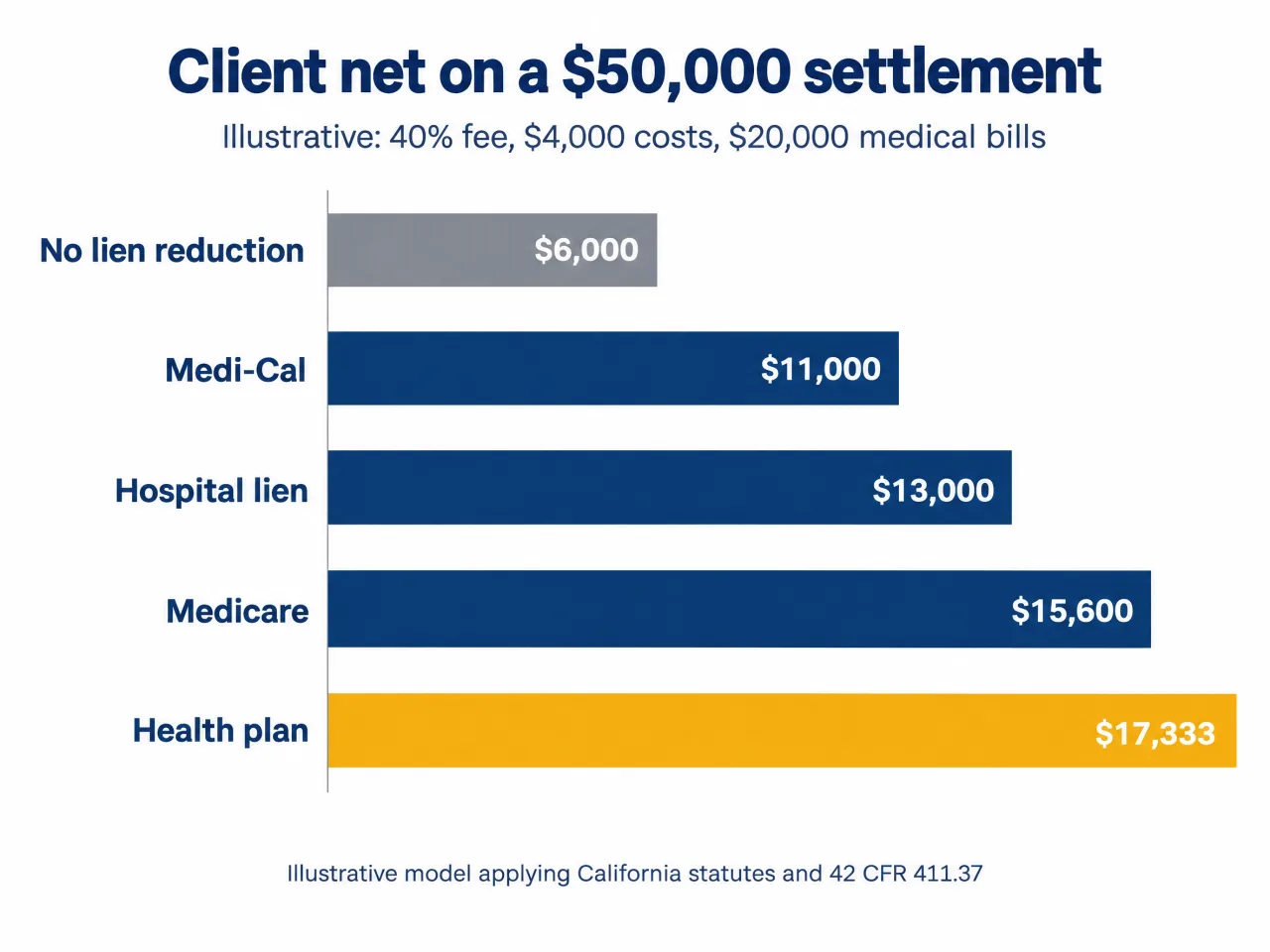
On the $50,000 example, repaying the full $20,000 in medical bills leaves $6,000. Applying the statutes lifts the net to between $11,000 and $17,333 depending on who holds the lien. The spread is widest in the middle of the range, where medical bills are a large share of the settlement. At the top end — catastrophic injuries where a carrier’s policy is in play — the fee and costs dominate, which is why documenting future care and lost earning capacity matters more than any lien reduction.
Estimate your own net
Enter your numbers. The calculator uses the same formulas as the table above.
- Attorney fee
- $20,000
- Case costs
- $4,000
- Lien repaid
- $8,667
- Estimated net to you
- $17,333 (35% of gross)
- Net with no statutory reduction
- $6,000
Illustrative only. Assumes one lienholder holds the whole medical balance and applies only the statutory formula — no negotiated reduction. Actual liens, fee agreements, and costs vary; ask your attorney for a written settlement statement.
Why truck cases change the math
Truck crashes differ from car crashes in two ways that affect the net. First, the available coverage is larger: federal rules require interstate freight carriers to carry at least $750,000, and many carry more, so the gross is less often capped by a small policy. Second, the cases cost more to win. Accident reconstruction, trucking-safety experts, and black box downloads are case costs, and a filed truck lawsuit typically triggers the higher fee tier. Multiple defendants — the carrier, trailer owner, broker, or shipper identified under truck accident liability rules — can raise the gross enough to outweigh those costs.
Time is part of the cost
Industry data reported from the Insurance Research Council’s 2017–2022 claims database (7.4 million auto injury claims) shows the share of claimants with attorneys rose from 40% to nearly 50%, litigation rose from 10% to 18% of claimants, and represented bodily-injury claims took a median of roughly 440 days to close — more than twice as long as unrepresented claims. The full report is available only to IRC members, so these figures are cited as reported. Waiting for maximum medical improvement is usually worth it, because settling early can leave future care unpaid — but it is also why California’s two-year filing deadline should be tracked from day one. Our filing deadline calculator gives the date.
Five questions to ask before you sign a settlement statement
- Is the fee calculated on the gross, and did it step up because suit was filed?
- What are the itemized case costs, and were any charged at a markup?
- Which liens are statutory (health plan, hospital, Medi-Cal, Medicare), and was each statutory reduction applied?
- Did anyone negotiate the liens below the statutory ceiling?
- Are any providers treating on a lien, and what did they agree to accept?
If you have not settled yet and want these questions answered by a California-licensed truck attorney, start a free case review.
Methodology
Researched September 23, 2026. Lien limits are taken from the current text of California Civil Code §§3040 and 3045.4, Welfare & Institutions Code §§14124.72 and 14124.78, and 42 CFR 411.37. Worked examples use hypothetical inputs and apply one lienholder’s formula to the entire medical balance; the health-plan column applies the one-third cap and then the pro-rata fee-and-cost reduction. Claims-duration figures are from the Insurance Research Council as reported in secondary coverage. Reddit breakdowns are user-reported and shown as examples only. Excluded for lack of a primary source: the commonly repeated claims that injured people “keep 60%–70%” of a settlement and that represented claimants net less per dollar of medical bills. This page is general information, not legal or tax advice; your lien amounts depend on your policies and treatment.
Sources
- 42 CFR § 411.37 — Amount of Medicare recovery when a primary payment is made as a result of a judgment or settlement — Cornell LII / eCFR
- California Civil Code § 3040 — Health care plan liens — FindLaw
- California Civil Code § 3045.4 — Hospital liens — FindLaw
- California Welfare & Institutions Code § 14124.72 — Medi-Cal lien reduction — FindLaw
- California Welfare & Institutions Code § 14124.78 — Medi-Cal recovery ceiling — Justia
- California Business & Professions Code § 6147 — Contingency fee contracts — California Legislative Information
- Auto Injury Insurance Claims: A Study of Increasing Claim Severity — Insurance Research Council
- “$42.5k car accident settlement, attorney/medical bills leave me with $1,077” — r/Insurance (Reddit)
Federal regulations and crash statistics are updated periodically. Figures cited on this page reflect the referenced publications at the time of writing; check the source for the current edition.