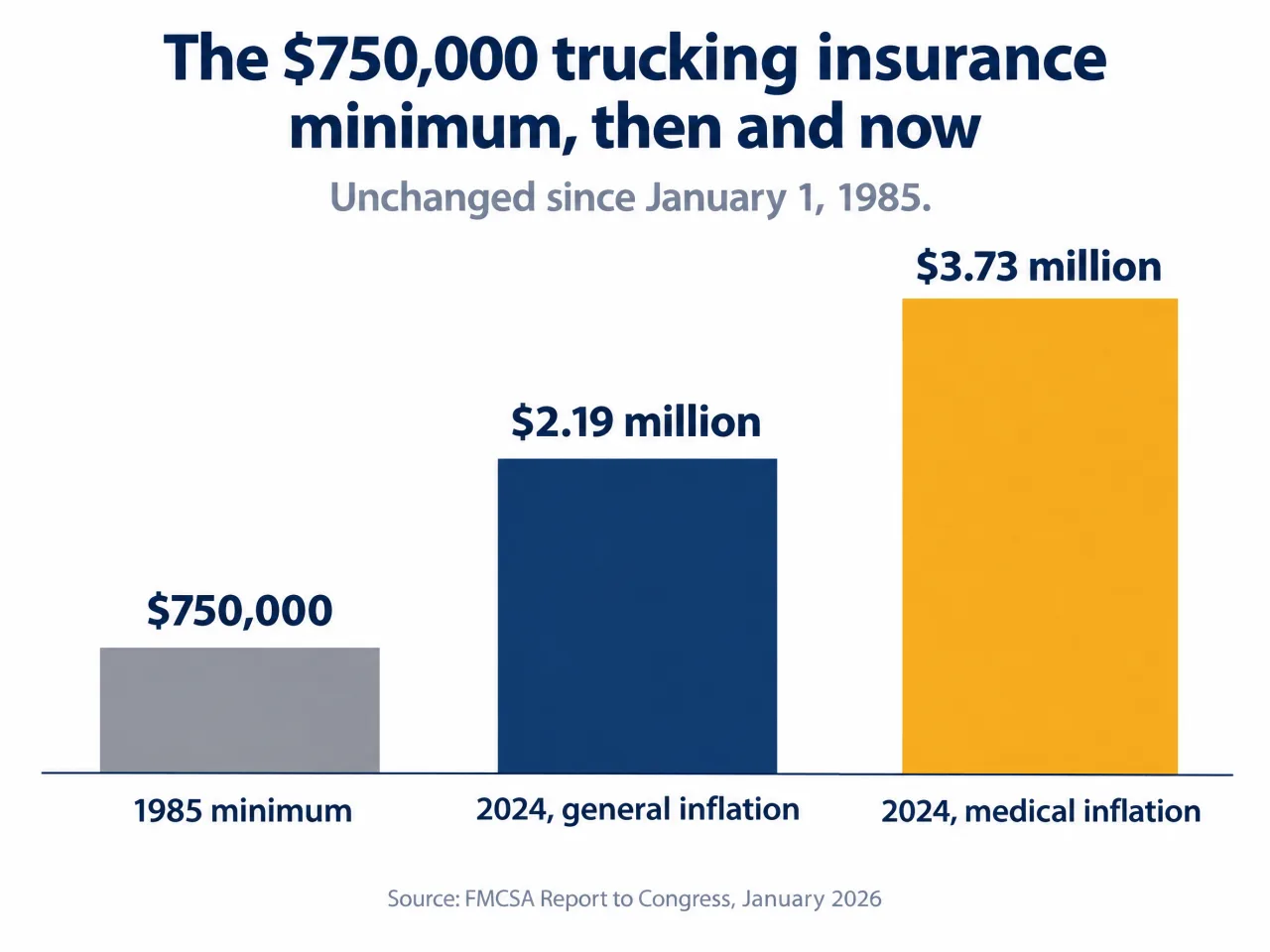
When one truck injures several people, everyone draws from the same per-accident policy limit. The federal minimum for general freight is $750,000 (49 CFR 387.9), a level unchanged since January 1, 1985 — FMCSA’s January 2026 report to Congress puts it at about $2.19 million in today’s dollars, or $3.73 million adjusted for medical costs. Most heavy trucks carry $1 million. If total damages exceed the limit, the insurer may settle claim by claim or ask a court to divide the money through interpleader, and other policies may have to fill the gap.

Multi-vehicle truck crashes create a problem single-car crashes rarely do: there may not be enough insurance for everyone. A commenter on a January 2026 r/Insurance thread about a semi that rear-ended several cars put it plainly — with multiple vehicles involved, the total for all of them has to fit under the truck’s limit. This page shows what that limit usually is, how it is divided, and where else money can come from in a semi-truck accident claim.
The federal minimums: $750,000 to $5 million
Federal law sets the floor for interstate carriers by what they haul.
| Carrier type | Minimum | Source |
|---|---|---|
| For-hire interstate general freight | $750,000 | 49 CFR 387.9 |
| Oil and certain other hazardous materials | $1,000,000 | 49 CFR 387.9 |
| Other hazardous materials (e.g., in cargo tanks) | $5,000,000 | 49 CFR 387.9 |
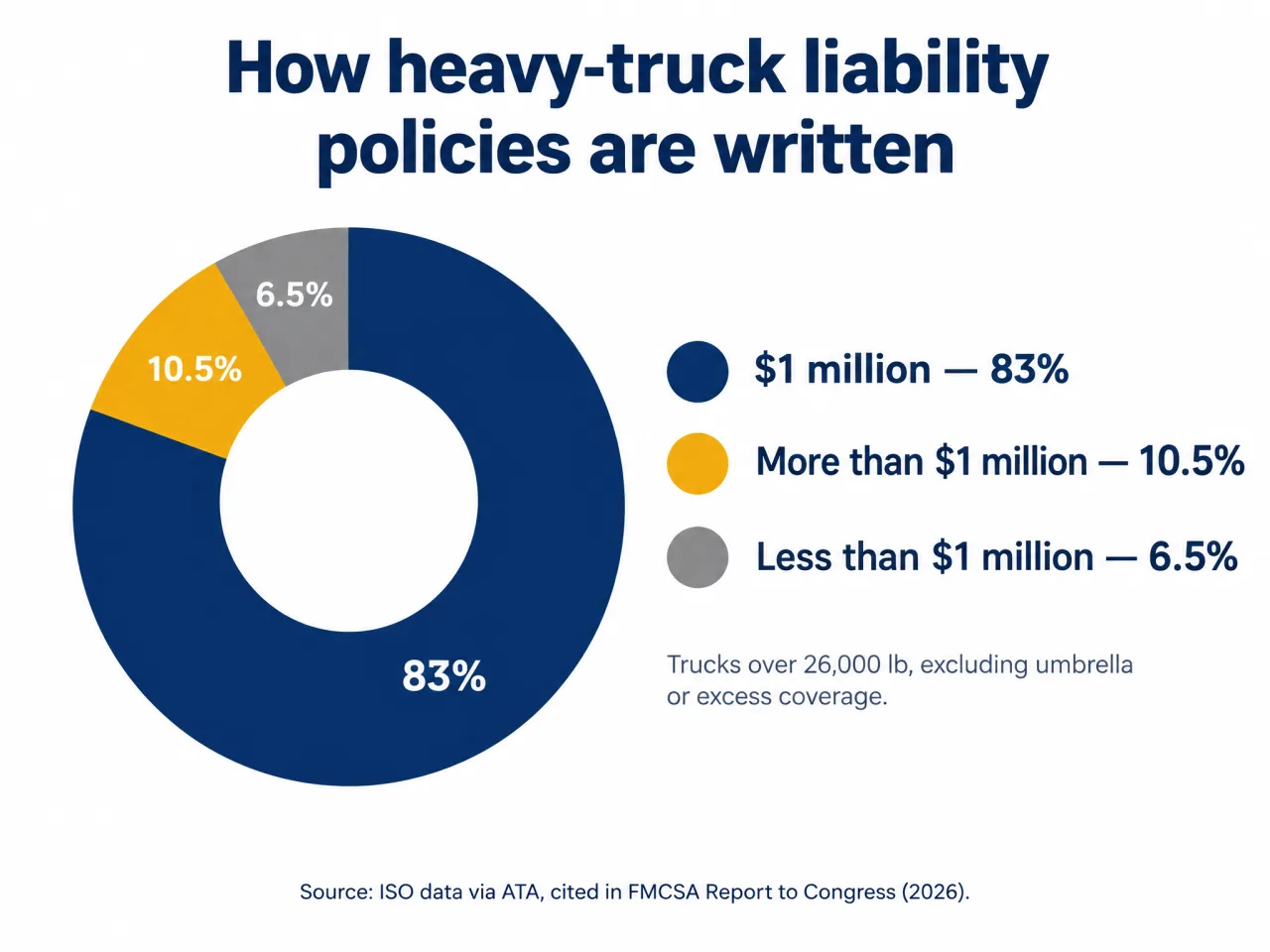
These are minimums, not typical coverage. According to ISO data compiled by the American Trucking Associations and cited in FMCSA’s 2026 report, 83% of liability policies for trucks over 26,000 lb are written at $1 million, 10.5% above $1 million, and 6.5% below — not counting umbrella or excess coverage. That dataset dates from around 2015; FMCSA notes it has no newer industry-wide figures.
A 1985 number: $750,000 would be $3.73 million today
The property-carrier minimums took effect January 1, 1985 and have not changed. FMCSA’s January 2026 report adjusted them using Bureau of Labor Statistics price indexes.
| Carrier type | 1985 minimum | 2024, core CPI | 2024, medical CPI |
|---|---|---|---|
| General freight | $750,000 | $2,192,825 | $3,725,822 |
| Hazardous materials (low) | $1,000,000 | $2,923,767 | $4,967,762 |
| Hazardous materials (high) | $5,000,000 | $14,618,836 | $24,838,811 |
Medical costs drive the gap: the medical price index rose 4.21% a year from 1985 to 2024 versus 2.80% for core prices, per the same report. DOT’s value of a statistical life, used to price fatal crashes, was $13.2 million as of 2024. FMCSA concluded the minimums can fall well short in fatal and severe-injury crashes, but said it could not fully measure the gap because many settlements are confidential and insurer data is proprietary. The report does not propose a new minimum.
How often a truck claim exceeds the policy
Large claims are rare. That is why a single multi-victim crash can exhaust a policy that covers most crashes easily.
| Measure | Value | Source |
|---|---|---|
| Chance a claim exceeds $500,000 | 1.40% | ISO data via ATA, cited by FMCSA (2026) |
| Chance a claim exceeds $1 million | 0.73% | ISO data via ATA, cited by FMCSA (2026) |
| Chance a claim exceeds $2 million | 0.31% | ISO data via ATA, cited by FMCSA (2026) |
| Crashes exceeding the minimums | Under 1% | Volpe study, cited by FMCSA (2026) |
| Settlement exposure that would exceed $750,000 coverage | 42% of exposure studied | Volpe study, cited by FMCSA (2026) |
The 42% figure measures dollars, not crashes: in the settlements Volpe studied, 42% of trucking companies’ monetary exposure would have exceeded their coverage had they carried only the $750,000 minimum. Big losses are concentrated in a small number of catastrophic crashes — the ones with fatalities or spinal cord injuries, and often several victims at once.
You may see a “$51 million median nuclear verdict” quoted against the $750,000 minimum. That figure, from Marathon Strategies, is the 2024 median “nuclear” verdict against corporate defendants across all industries — not a trucking statistic. FMCSA’s report cites it as general context only.
How one limit gets divided
A per-accident limit is a single pot. When combined claims exceed it, there are two common paths. The insurer may negotiate settlements one claimant at a time until the limit is used. Or it may file an interpleader: under California Code of Civil Procedure §386, a party facing multiple claims can deposit the amount it admits is owed with the court and have the claimants litigate how to divide it. Courts may also award the depositing party its costs and reasonable attorney fees from the deposit.
The calculator below shows one simple way a limit can be shared — proportionally to each person’s damages. It is an illustration, not a prediction; real splits depend on negotiation, fault, and the court.
- Total claimed
- $1,500,000
- Claimant 1
- $600,000 (short $300,000)
- Claimant 2
- $266,667 (short $133,333)
- Claimant 3
- $133,333 (short $66,667)
- Uncovered by this policy
- $500,000
Illustrative pro-rata split of a single policy. Insurers may settle claimants one at a time, and courts can divide an interpleaded limit differently. Other policies — excess or umbrella coverage, a broker, shipper, or trailer owner, and your own underinsured-motorist coverage — may cover the shortfall.
Where else the money can come from
The truck’s primary policy is rarely the only source. A thorough investigation of every liable party commonly looks at:
- Excess or umbrella policies sitting above the carrier’s primary coverage.
- The trailer owner, shipper, or cargo loader, when loading or equipment contributed.
- A freight broker that selected an unsafe carrier.
- The truck or parts manufacturer, in a defect case.
- Your own underinsured-motorist coverage, if the at-fault policies run out.
Finding those policies depends on records — carrier filings, the driver’s dispatch paperwork, and the black box data described in our guide to FMCSA regulations as evidence. Each extra defendant adds costs, which affects what you actually keep after fees and liens, but in a multi-victim crash it is often the only way everyone is paid.
What to do if you were one of several victims
Get medical care and keep records first. Then avoid signing a release with the carrier’s insurer before you know the policy limit and whether other claimants exist. California’s two-year filing deadline still applies, and the policy can be committed to other claimants long before it. A free case review connects you with a California-licensed truck attorney who can request the coverage information.
Methodology
Researched September 23, 2026. Minimum levels are from 49 CFR 387.9. Inflation adjustments, policy distribution, claim-size probabilities, and the Volpe findings are taken from FMCSA’s January 2026 report to Congress, read in full; figures it cites from older studies are dated in the text. The interpleader description is from California Code of Civil Procedure §386. Excluded: vendor claims that FMCSA will propose a $2 million to $5 million minimum in 2026 or 2027, which do not appear in the report. The calculator uses a hypothetical pro-rata split. This page is general information, not legal advice.
Sources
- Examining the Appropriateness of the Current Financial Responsibility and Security Requirements for Motor Carriers, Brokers, and Freight Forwarders — Report to Congress (January 2026) — FMCSA
- 49 CFR § 387.9 — Financial responsibility, minimum levels — Cornell LII / eCFR
- California Code of Civil Procedure § 386 — Interpleader — Justia
- FMCSA spotlights trucking’s multi-million dollar insurance gap (Feb. 27, 2026) — FreightWaves
- Corporate Verdicts Go Thermonuclear (2025) — Marathon Strategies
- “Semi truck accident. Is it worth to contact a lawyer for claim” — r/Insurance (Reddit)
Federal regulations and crash statistics are updated periodically. Figures cited on this page reflect the referenced publications at the time of writing; check the source for the current edition.