On December 1, 2025 FMCSA consolidated 959 individual violations into 116 Violation Groups, renamed BASICs to Compliance Categories, and collapsed severity weights from a 1-to-10 scale to two tiers. It is the most significant Safety Measurement System overhaul since CSA launched in 2010, and it changes how safety-score evidence should be cited in a truck accident case.
Last updated 2026-09-20 · Reflects the December 1, 2025 SMS overhaul (Federal Register 2024-27087).
For fifteen years, FMCSA’s Safety Measurement System (SMS) has been one of the most cited pieces of evidence in truck accident cases. It is public, it is searchable at SAFER, and it puts every U.S. motor carrier on a comparable scale. On December 1, 2025 the whole system was rebuilt — new category names, a new violation taxonomy, a new severity scale, and a new lookback rule. If you file, defend, or settle truck cases, the SMS printout on your desk is either from the old system or the new one, and getting that wrong in a brief is avoidable.
This article is a plaintiff-side walkthrough of what changed and why it matters — not a fleet-manager compliance overview. If your case involves a carrier whose SMS record is central, a big rig truck accident lawyer can pull the right vintage of the profile; start with a free case review.
The five headline changes, in one table
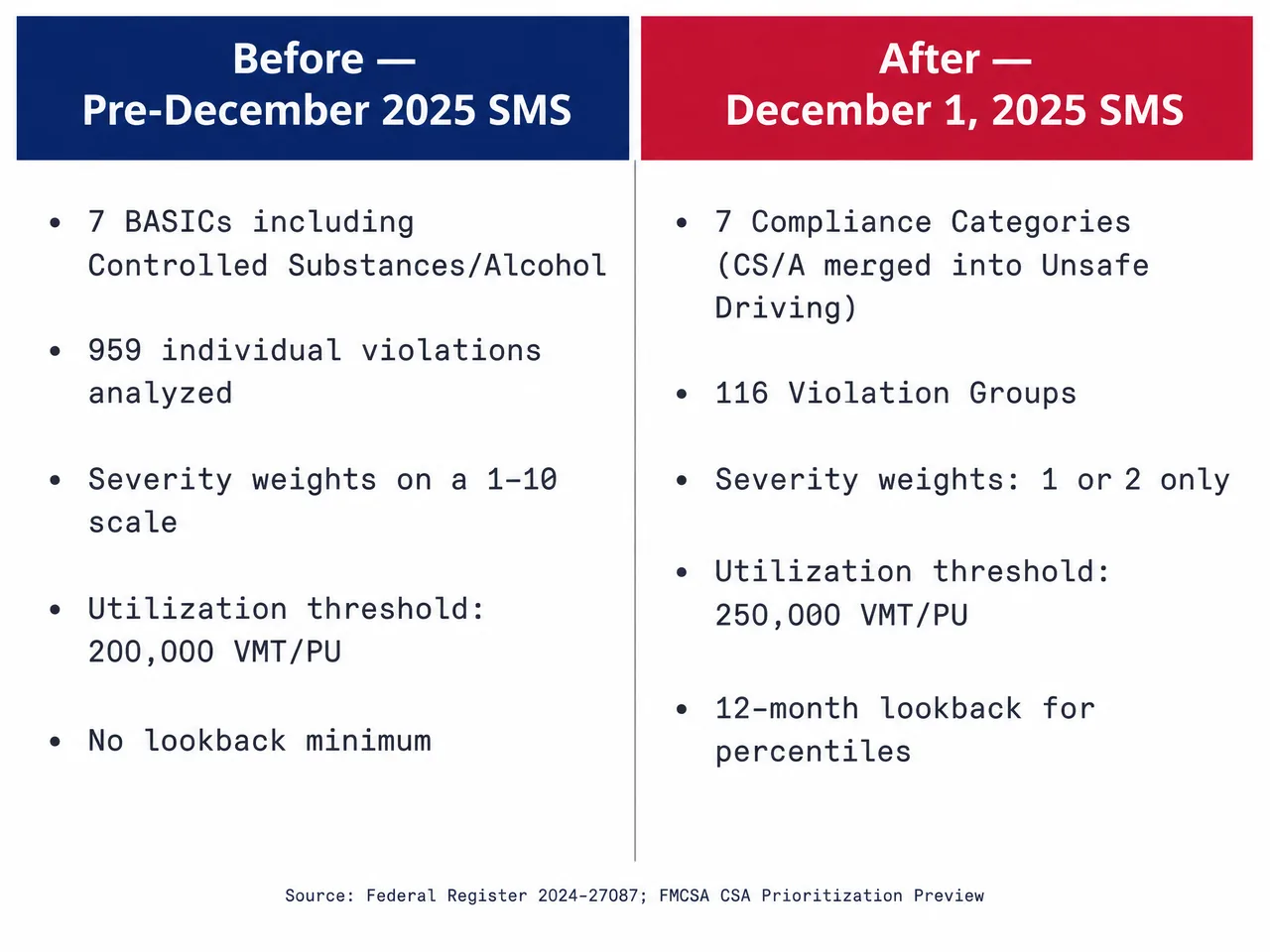
| What changed | Before December 1, 2025 | After December 1, 2025 |
|---|---|---|
| Category naming | 7 Behavior Analysis and Safety Improvement Categories (BASICs) | 7 Compliance Categories (Controlled Substances/Alcohol removed and merged into Unsafe Driving; new Vehicle Maintenance: Driver Observed category added) |
| Violation taxonomy | 959 individual violations, scored line by line | 116 Violation Groups — similar violations bundled (HOS specifically dropped from 73 to 9 groups) |
| Severity weights | 1-to-10 scale, per-violation weighting | Two tiers: Weight 2 for Out-of-Service and 49 CFR 383.51 disqualifying offenses; Weight 1 for everything else |
| Utilization Factor threshold | 200,000 VMT per average Power Unit | 250,000 VMT per average Power Unit |
| Lookback rule | Percentiles calculated when the carrier had record activity | 12-month lookback: percentiles only calculated if the carrier has ≥1 roadside violation in the category within the past 12 months |
The definitive violation count is 116, not ~100
"The updated SMS methodology groups 959 violations into 116 Violation Groups… simplified severity weights replacing a 1-10 scale with a 2-value scale."
— Federal Register 2024-27087, Enhanced Carrier Safety Measurement System, cross-verified in FMCSA CSA Prioritization Preview Q&A materials.
Most trade press coverage of the change reports "approximately 100" groups. That number is a rounded restatement. When the specific count matters in a brief, cite 116 and cite the Federal Register notice.
How the SMS got here: a fifteen-year timeline
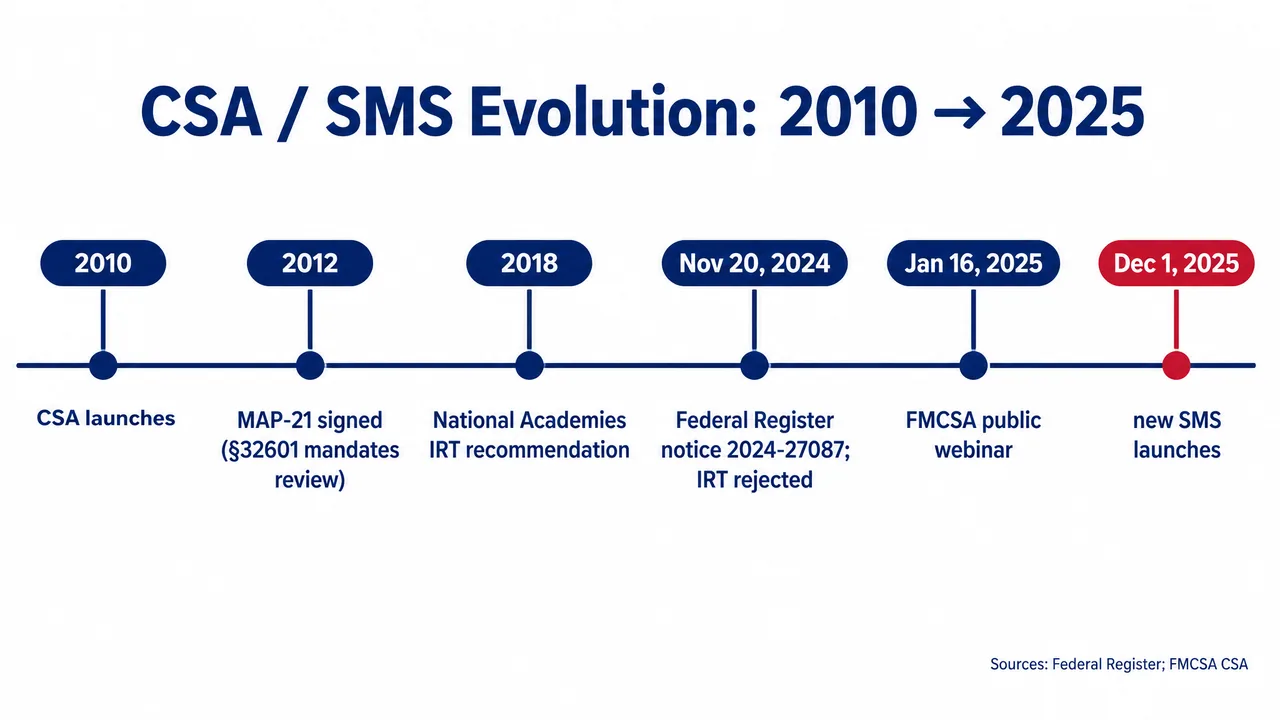
The current overhaul is the endpoint of a decade of debate about whether SMS scores are statistically valid. Understanding the arc helps a fact-finder understand why the numbers changed and what they now mean.
- December 2010: FMCSA launches Compliance, Safety, Accountability (CSA) and the SMS. Seven BASICs anchor the system.
- 2015–2017: Congress orders the National Academies of Science (NAS) to review SMS methodology. The 2017 NAS report recommends Item Response Theory (IRT) as a replacement statistical model.
- 2017–2024: FMCSA drafts, tests, and iterates. IRT is piloted but ultimately abandoned — FMCSA determines it is too inherently complex and does not measurably improve carrier risk identification.
- November 20, 2024: Federal Register notice 2024-27087 publishes the final SMS methodology overhaul.
- January 16, 2025: FMCSA hosts a public webinar walking industry through the changes.
- December 1, 2025: New methodology takes effect. SAFER now surfaces the new categories and Violation Groups on every carrier profile.
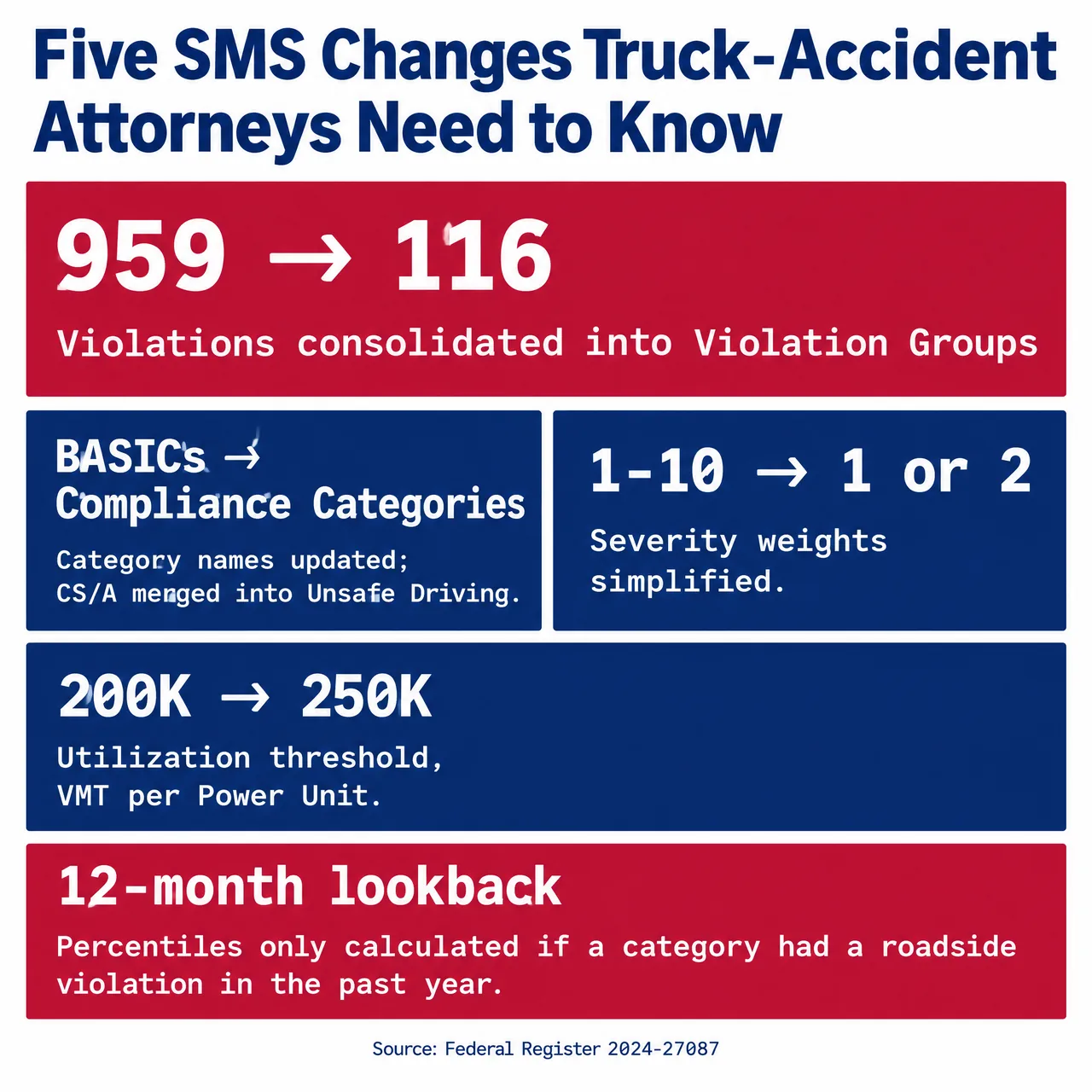
The five changes attorneys need to know
1. BASICs are Compliance Categories now
Rename, plus one merger and one addition. Controlled Substances/Alcohol violations are now scored under Unsafe Driving rather than a standalone category. A new Vehicle Maintenance: Driver Observed category captures deficiencies a driver flagged that management did not remediate. In practice, older briefs that cite "the Controlled Substances/Alcohol BASIC" on a carrier’s pre-2025 profile need to reconcile with post-2025 profiles that no longer show that category.
2. 959 violations became 116 Violation Groups
This matters more than the naming change. Hours-of-Service violations alone collapsed from 73 individual codes down to 9 groups. When a carrier’s pre-2025 profile shows "12 HOS violations of eight different codes," the same evidence on a post-2025 profile may appear as three group-level entries. The underlying record has not changed; the presentation has. Discovery requests should reference the underlying inspection records, not just the grouped presentation.
3. Two-tier severity replaces the 1–10 scale
Weight 2 = Out-of-Service or 49 CFR 383.51 disqualifying offense. Weight 1 = everything else. The old system allowed a plaintiff to argue that a specific violation was "weighted 8 out of 10" — a rhetorically useful frame that no longer exists. Under the new system, argue Out-of-Service or non-Out-of-Service, and cite the underlying regulation directly.
4. Utilization Factor threshold raised to 250,000 VMT
Small carriers with lower mileage exposure now face a higher activity threshold before their scores stabilize. A carrier that scored high on a specific BASIC under the old 200,000 VMT rule may not show a comparable percentile under the new 250,000 rule if their fleet utilization is low.
5. 12-month lookback for percentile calculation
Under the old system, historical violations continued to drive percentile calculations even years later. Under the new rule, if a Compliance Category has no roadside violation within the past 12 months, no percentile is calculated. The historical violations still exist in the record — SAFER continues to display them — but they no longer produce a category score.
This is the change most likely to catch attorneys off-guard in the transition period. A carrier with a bad pre-2024 history and a clean 2025 record may appear to have "improved" when what has actually happened is that the lookback window has narrowed.
How to pull the right SMS printout in discovery
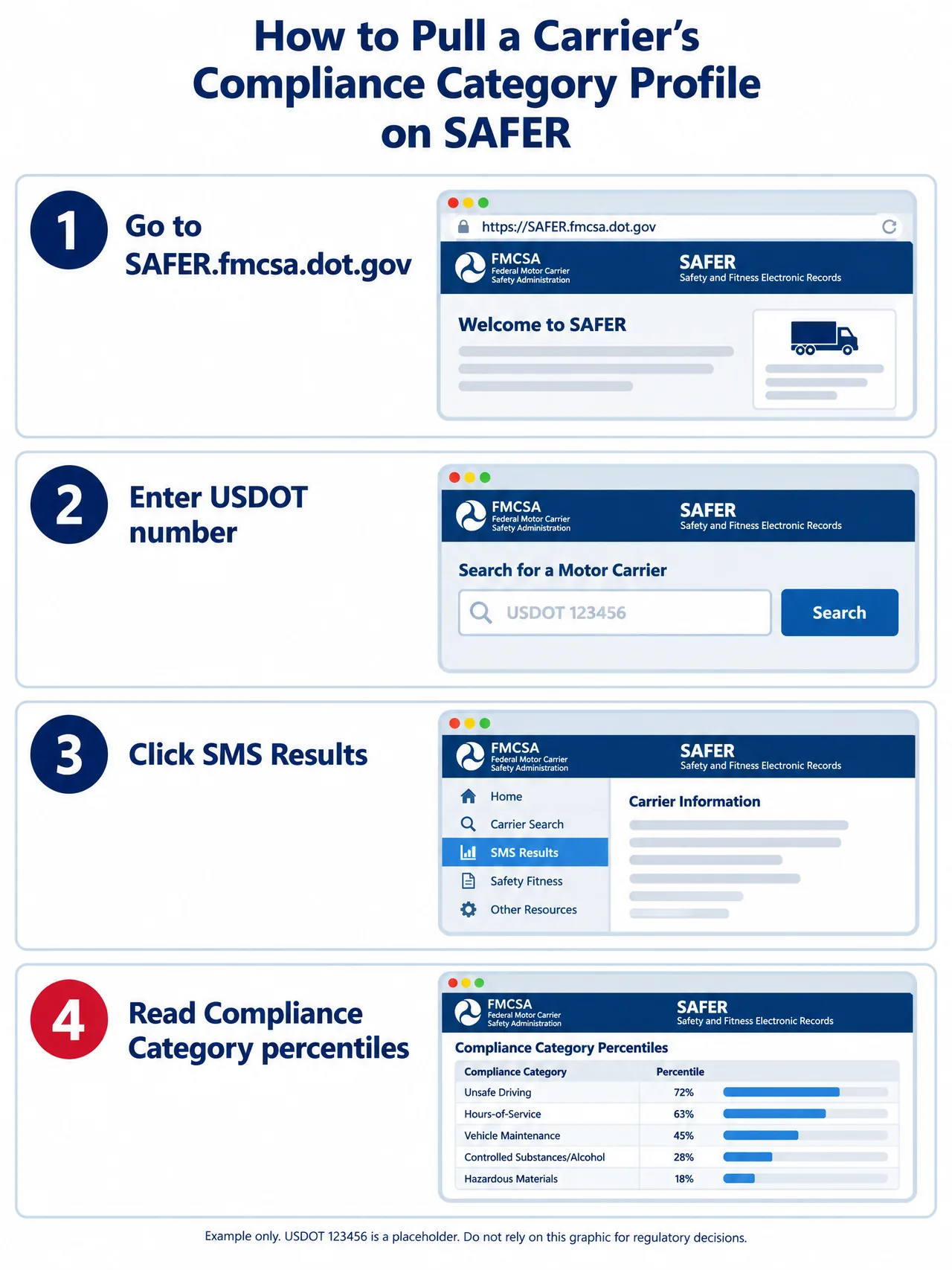
SAFER (safer.fmcsa.dot.gov) is the public front door. The CSA Prioritization Preview portal at csa.fmcsa.dot.gov/prioritizationpreview publishes the new methodology and the underlying documentation. For a specific carrier — no real carriers named here — the discovery pattern that reliably captures both the old and new pictures is:
- Request the carrier’s SAFER Company Snapshot as of the date of the crash, and again as of the date of the discovery request. Both are date-stamped.
- Request the SMS Public Snapshot for the same two dates. The pre-December-2025 version shows BASICs and the 1–10 scale; the post-December-2025 version shows Compliance Categories and Violation Groups.
- Request the underlying roadside inspection reports — the raw evidence beneath either presentation. The methodology change did not touch the inspection records themselves.
- If percentile testimony is central to your case, request the carrier’s Utilization Factor figures used in the percentile calculation for both eras. A shift from the old 200,000 to the new 250,000 VMT threshold can produce dramatic percentile movement without any underlying safety change.
See FMCSA regulations and the evidence that wins truck accident cases for the surrounding evidence-preservation playbook, and who can be held liable when the carrier’s safety record supports vicarious or direct-negligence theories.
What did not change
The overhaul was methodological. It did not change:
- The underlying regulations. HOS limits, maintenance duties, drug and alcohol testing, and insurance minimums are unchanged. Only how violations of those regulations are aggregated into scores changed.
- The roadside inspection process. State enforcement officers still write the same inspection reports; only how those reports feed the score changed.
- The discoverability of a carrier’s history. Historical violations remain in the record and remain admissible under state discovery rules.
- The public visibility of the SAFER Company Snapshot. It remains free and searchable.
The IRT decision — FMCSA’s rejection of the National Academies of Science recommendation to move to Item Response Theory — is also a practical point. It means the scoring model is still additive and percentile-based, just simplified. Reporting that called for a more statistically sophisticated model did not win the day.
Practical takeaway
Every SMS citation in a truck accident case now has two eras. Before December 1, 2025: BASICs, 959 violations, 1–10 severity. On and after December 1, 2025: Compliance Categories, 116 Violation Groups, two-tier severity, 12-month lookback. Reconcile the two in the record. Cite the Federal Register notice. Preserve the underlying inspection records regardless of which presentation shows them.
If a truck crash on or after November 2024 is central to your case and the carrier’s SMS record matters, a free case review is the first step. Records live inside FMCSA and inside the carrier — waiting preserves neither.
Sources
- Enhanced Carrier Safety Measurement System (Federal Register 2024-27087) — U.S. Federal Register
- CSA Prioritization Preview (official landing) — FMCSA
- FMCSA SMS Changes Part 1 (Jan 16, 2025 webinar deck) — FMCSA
- What's Changing in the FMCSA SMS — FMCSA
- FMCSA Implements Improvements to Its Safety Measurement System — FMCSA Newsroom
- FMCSA proposes long-awaited changes to CSA, eliminates IRT (industry reporting) — FleetOwner
Federal regulations and crash statistics are updated periodically. Figures cited on this page reflect the referenced publications at the time of writing; check the source for the current edition.