A jackknife accident happens when a tractor-trailer folds at the coupling and the trailer swings out past the cab. Past roughly 45 degrees the driver cannot recover, and a 53-foot trailer sweeps across multiple lanes in seconds. Liability usually rests with the driver, the motor carrier, or whoever loaded the trailer — often more than one.
A jackknife accident occurs when a tractor-trailer folds at the coupling — the trailer swings outward past the cab like a closing pocketknife. Once the trailer's angle exceeds roughly 45 degrees, the driver has effectively lost control, and a 53-foot trailer can sweep across several lanes of traffic in seconds, crushing or sideswiping everything in its path.
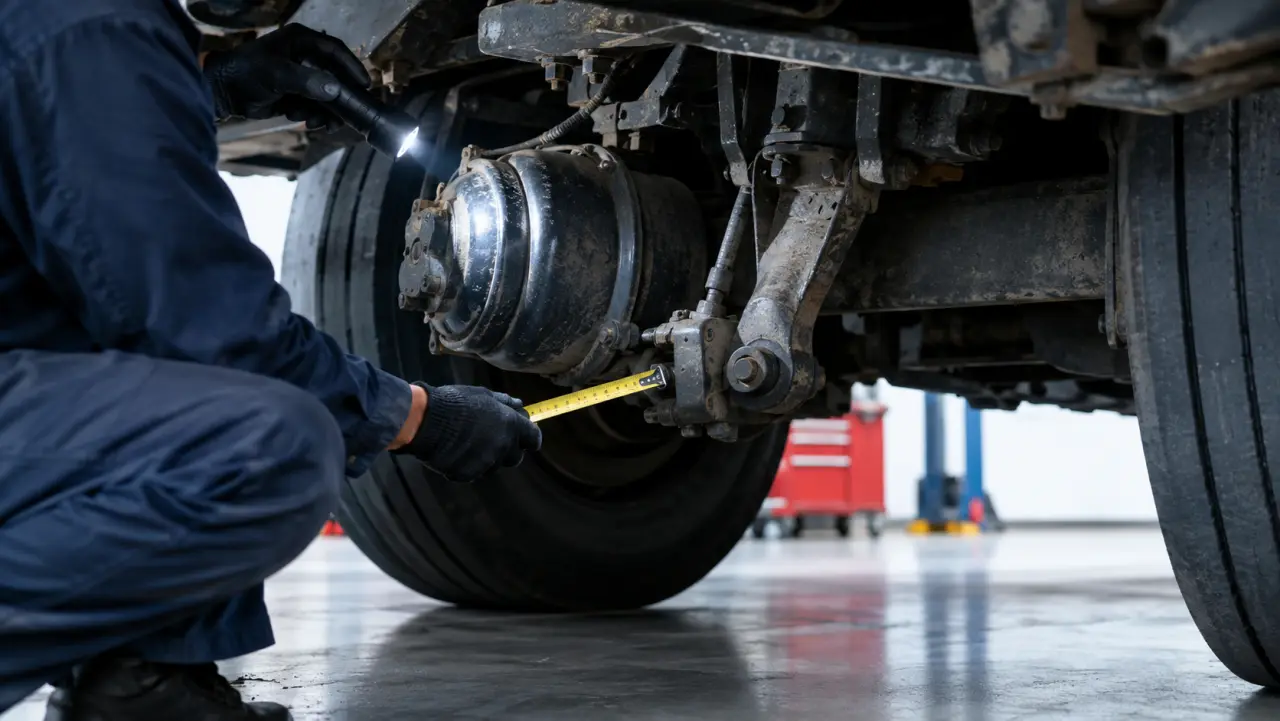
The physics matter legally as well as mechanically. Jackknifing is a traction-imbalance event: the trailer keeps its momentum while the tractor slows or loses grip. That imbalance is nearly always traceable to a decision someone made before the crash — how fast to take the grade, whether to slow for rain, whether to replace brake shoes that measured out of adjustment at the last inspection, how to distribute the load. Which is why these cases are won on records, not on eyewitness impressions.
What causes a big rig to jackknife?
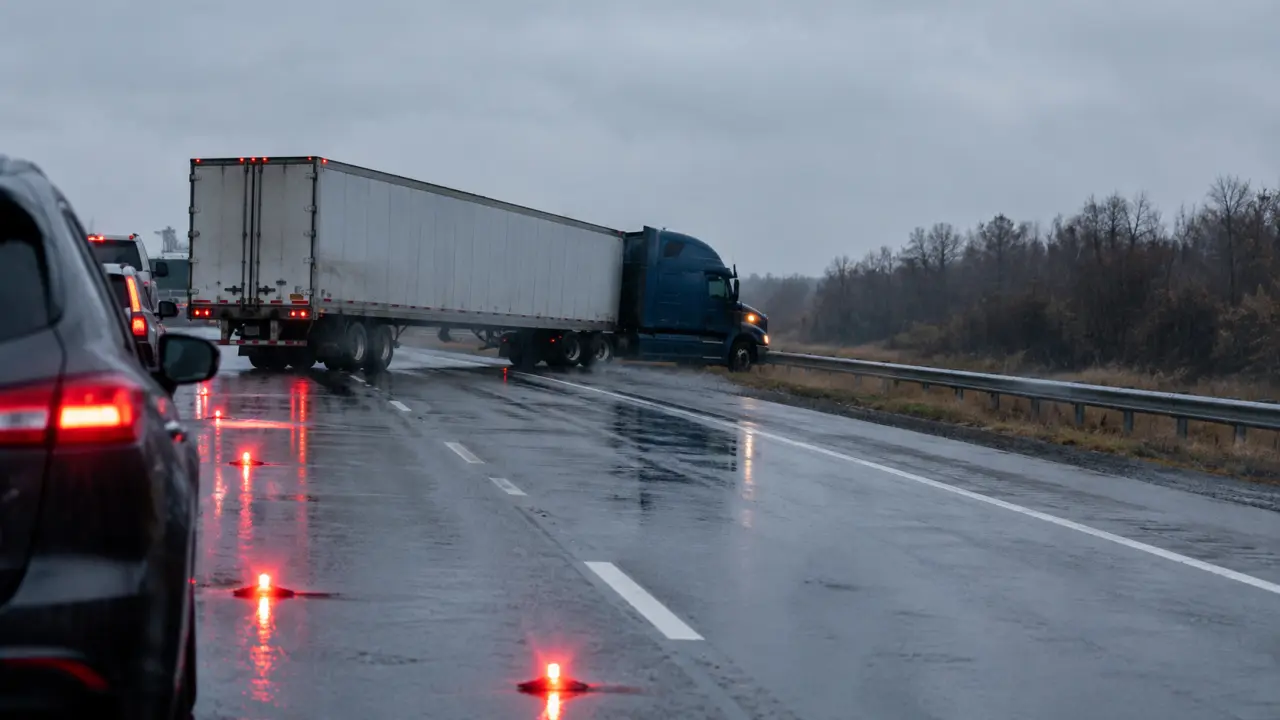
- Hard braking at speed. When the tractor's drive wheels lock or the trailer's momentum overruns the cab, the trailer pivots. Late braking is often a symptom of driver fatigue, speeding, or following too closely.
- Slick roads. Rain, ice, and snow reduce trailer traction. This is not merely good practice — under 49 CFR § 392.14, a commercial driver must use extreme caution and reduce speed when hazardous conditions affect traction, and must stop driving entirely when conditions become sufficiently dangerous.
- Improperly loaded or light cargo. An unbalanced or nearly empty trailer is far more likely to swing, because there is less weight pressing the trailer tires into the road. Cargo distribution and securement are governed by 49 CFR Part 393 Subpart I, and the shipper or loading company may share fault — see cargo shift accidents.
- Brake defects or poor maintenance. Mismatched or poorly adjusted brakes cause uneven braking force between tractor and trailer. 49 CFR Part 393 Subpart C requires brakes on all wheels and that they be maintained in adjustment; Part 396 requires systematic inspection, repair, and maintenance with records the carrier must produce. See brake failure accidents.
- Curves and downgrades taken too fast. Speed management on grades is a core commercial driving skill, and failure to train for it is a claim against the carrier rather than the driver.
Who can be held liable?
Jackknifing is almost always preventable, which is why these cases often come down to proving which failure started the chain:
- The driver — speeding, tailgating, or braking improperly for conditions
- The trucking company — negligent training, unrealistic schedules, or poor maintenance programs
- The cargo loader — unbalanced or unsecured freight
- A maintenance contractor or manufacturer — defective brakes, blown tires, or coupling components
The carrier is the defendant that usually matters most, because it carries the federally mandated minimum insurance under 49 CFR Part 387 and is vicariously liable for its driver. A carrier's prior violation history is public: the FMCSA Safety Measurement System publishes inspection and violation data by BASIC category, and a pattern of vehicle-maintenance violations before the crash is powerful evidence that the jackknife was foreseeable. Read more on who can be held liable.
What evidence proves the claim
A big rig truck accident lawyer will typically retain an accident reconstruction expert and pull the truck's event data recorder, which captures speed, brake application, and steering input in the seconds before the crash. The other records that decide these cases:
- Driver duty-status records. Electronic logging device data shows how long the driver had been on duty. 49 CFR § 395.8 requires carriers to retain these for six months — which is also how long you have before they can be lawfully destroyed.
- Inspection and maintenance files under Part 396, including the last brake adjustment measurements.
- Post-crash brake and tire measurements, taken before the vehicle is repaired or sold.
- Dashcam, traffic camera, and nearby business footage, most of which is overwritten within days.
Because that six-month retention clock and the overwriting of onboard data both start on the day of the crash, a preservation demand should go out immediately. Learn how this evidence works on our FMCSA regulations & evidence page, and see how long you have to file a truck accident claim.
Injuries and compensation

Because a jackknifing trailer strikes vehicles broadside or crushes them against barriers, injuries are frequently catastrophic — brain injuries, spinal damage, and fatalities. Compensation can include medical care, lost earnings, pain and suffering, and in fatal cases, wrongful death damages. See what a truck accident settlement covers, or start a free case review now.
Related causes
Sources
- 49 CFR Part 393 Subpart C — Brakes — Electronic Code of Federal Regulations
- 49 CFR Part 396 — Inspection, repair, and maintenance — Electronic Code of Federal Regulations
- 49 CFR § 392.14 — Hazardous conditions; extreme caution — Electronic Code of Federal Regulations
- 49 CFR § 395.8 — Driver's record of duty status — Electronic Code of Federal Regulations
- Large Truck and Bus Crash Facts — Federal Motor Carrier Safety Administration
- Large Trucks — fatality facts and crash research — Insurance Institute for Highway Safety (IIHS)
- Safety Measurement System — carrier safety records by BASIC — FMCSA Safety Measurement System
Federal regulations and crash statistics are updated periodically. Figures cited on this page reflect the referenced publications at the time of writing; check the source for the current edition.